In my previous article on Measures of Linkedin Influence, the data showed that BCG and McKinsey are head and shoulders above their peers in terms of number of Linkedin followers, and even when controlled for company size, these two still come out on top.
There’s another measure of Linkedin influence where BCG and McKinsey are outliers: number of likes per post. This article explores some factors that contribute to a post getting liked, and highlights a few simple practices that you can implement to increase your post likes and overall Linkedin influence.
There’s another measure of Linkedin influence where BCG and McKinsey are outliers: number of likes per post.
Number of likes per Linkedin post: who are the top performing firms?
A “like” on a Linkedin post is a signal of reader approval. The number of likes a Linkedin post receives is then indicative of its value to its readers. So, it follows that companies that consistently get high numbers of likes to their posts are proficient at creating valuable content.
In order to understand how well consulting firms performed in creating valuable content to their readers, I compiled the average “likes per post” for 59 consulting firms over the period of Sep-Dec 2018. I then plotted this against number of posts per month as shown in the scatter plot below.
A “like” on a Linkedin post is a signal of reader approval. The number of likes a Linkedin post receives is then indicative of its value to its readers.
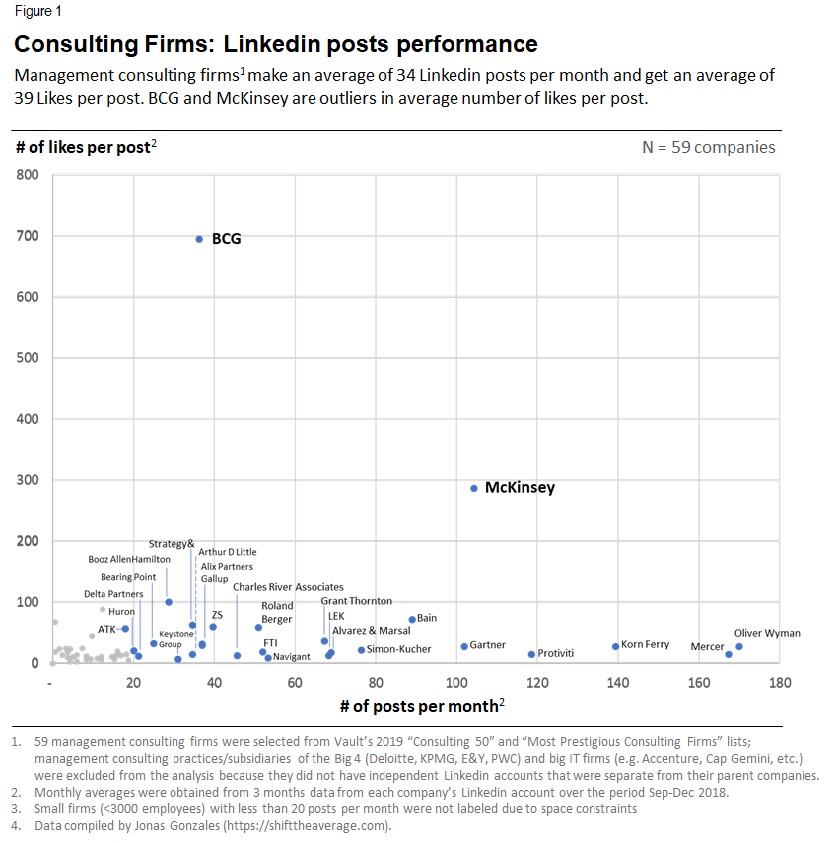
The data tells us that management consulting firms make an average of 34 Linkedin posts per month, and receive an average of 39 Likes per post (within 6 weeks of the posting date).
Figure 1 above shows us that BCG and McKinsey significantly outperform all other consulting firms in average number of likes per Linkedin post. Further analysis was conducted by controlling for number of followers (I calculated the “average likes per post divided by # of followers” for all 59 firms), and results showed BCG and McKinsey still near the top for big firms (>3,000 employees).
The graph also tells us that frequency of posts have little impact on number of likes per post, which is further validated by a low correlation coefficient (R=0.10) between these two variables.
Linkedin posts which get the highest number of likes
I did a qualitative analysis of the Linkedin posts of consulting firms in order to understand what posts get the most likes. I analyzed ~8,700 posts made by 59 consulting firms over the period of Sep-Dec 2018, and found the following:
- Linkedin posts of advisory/consulting companies can be classified under three general categories:
- Thought Leadership: articles that provide news, information, and insights to readers; mostly based on research and projects that the company has done.
- Recruitment: anything that directly or indirectly promotes recruitment for the company; some examples are: feature story on a company office (in a particular city), feature story on an employee, announcements of events/awards/partnerships/policies/etc. that showcase the company’s attractiveness as an employer, job openings, recruitment events, etc.
- Miscellaneous: anything that does not fall under the two categories above; most of these posts are announcements such as: company’s participation in international forums, a company partner to be the keynote speaker for a convention, company partnerships with other organizations, new partner joining the firm, promotions, etc.
- Posts on Thought Leadership, on average, received the highest number of likes.
- Even within the same Linkedin account, there is
a large variation in number of likes for thought leadership posts.
- Factors such as industry vertical and business topic potentially contribute to this variation.
- However, one factor that stands out which significantly affects number of likes is what I call “accessibility of value”. Simply put, this refers to the number of clicks that the reader has to make in order to get to the meat of the content (value). Posts that require fewer clicks (high accessibility of value) receive more likes. This is why you’ll be able to observe that Linkedin posts with infographics/charts/tables get the highest number of likes. For these posts, readers do not need to click on anything else in order to learn something new and thus receive something of value. This is one of the reasons why BCG thought leadership posts have the highest number of likes (even when we control for number of followers).
One factor that stands out which significantly affects number of likes is what I call “accessibility of value”. Simply put, this refers to the number of clicks that the reader has to make in order to get to the meat of the content (value). Posts that require fewer clicks (high accessibility of value) receive more likes.
- Miscellaneous posts received the lowest number of likes. In fact, there is a negative correlation between number of miscellaneous posts (as a % of total posts) and: average number of likes per post (R= -0.16), Linkedin influence index (R= -0.28).
Although these are correlation coefficient figures, the direction of causality is quite clear. And it simply means that:- The higher the % of miscellaneous posts you make (% of total posts), the average number of likes that your posts receive as a whole also go down; the fact that miscellaneous posts get very few likes of course contributes to this.
- The higher the % of miscellaneous posts you make (% of total posts), the less followers you get.
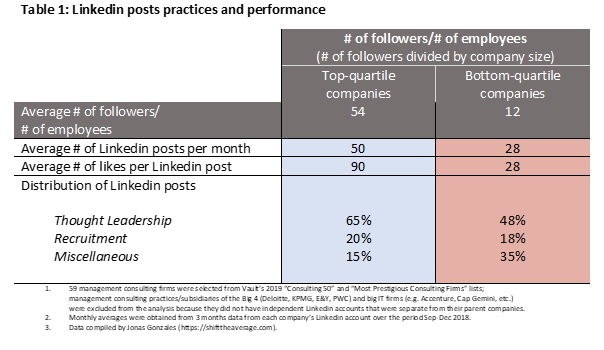
I also did an analysis of top-quartile and bottom-quartile companies based on Linkedin influence index scores (see my previous article on this metric), and found significant differences in their Linkedin posts practices and performance:
Three simple practices that can get you more followers and more post likes
The key takeaways from this analysis are:
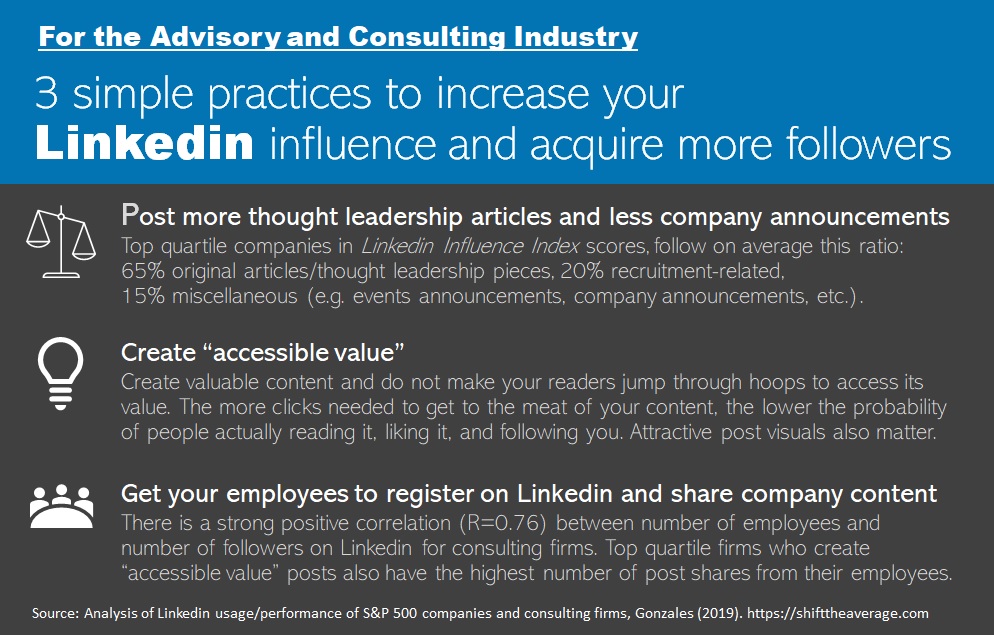
Post more thought leadership articles and less company announcements
- Create relevant and valuable content (thought leadership pieces, etc.) for your target audience. Before posting, ask yourself these questions:
- Will this provide my readers with information and updates that might be important for them?
- Will this help my readers make better business decisions?
- Will this help my readers get better at their work/business?
- Company announcements also matter, as they may help establish or strengthen your firm’s reputation/credibility. But it’s better to have less of these. Very few people really care if one of your firm partners is keynote speaker for some event.
- Top-quartile performers (based on Linkedin Influence Index scores) follow this ratio in their Linkedin posts:
- Thought Leadership 65%
- Recruitment 20%
- Miscellaneous 15%
Create “accessible value”
- Do not make your readers jump through hoops to access the value you create.
- The more clicks needed to get to the meat of your content, the lower the probability of people reading it, liking it, and following you.
- Attractive post visuals matter. Include a relevant photo in your post. Better yet, include infographics from which readers can already obtain value.
Get your employees to register on Linkedin and share company content
- Scale and reach matter. The more employees you have that are registered on Linkedin, the more people you have potentially sharing your content (and thus get more followers). The data supports this given the strong positive correlation (R=0.76) between number of employees and number of followers on Linkedin.
- This goes hand-in-hand with creating “accessible value” posts, as top quartile firms who create “accessible value” posts also have the highest number of post shares from their employees.
These may seem common sense, but the analysis shows they are not common practice. Implement them and separate your firm from the competition.
 shifttheaverage.com